


"Understanding VAR Systems in Live Sports Broadcasts"
- szymborskipiotr

- Aug 16, 2025
- 5 min read
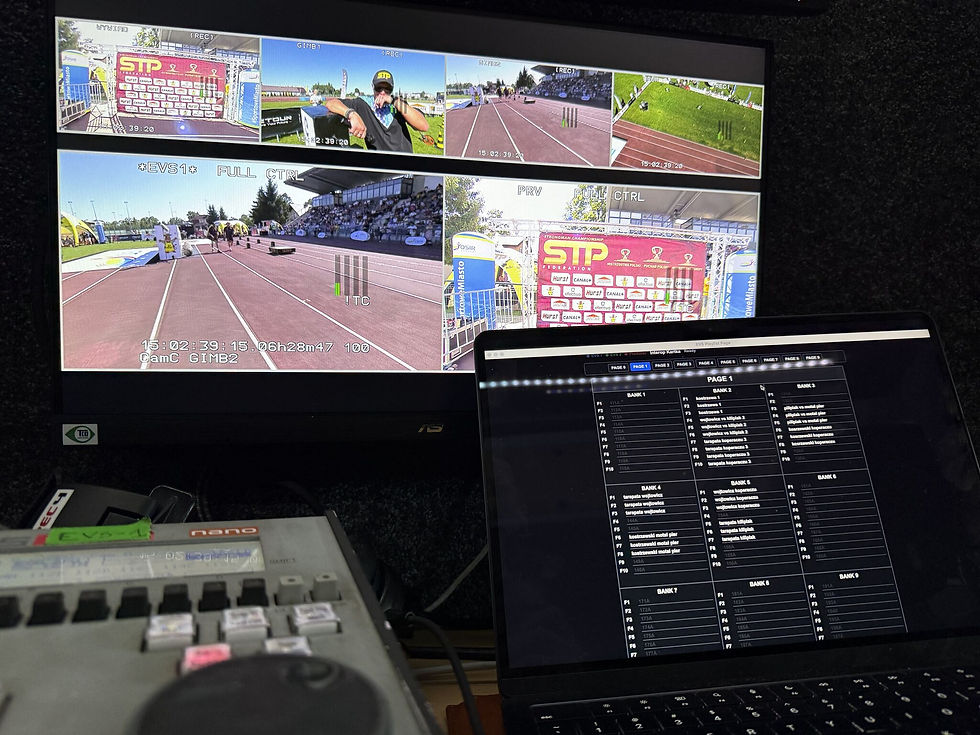
In the fast-paced world of professional sports, particularly association football (soccer), accuracy in officiating has become paramount. Enter the Video Assistant Referee (VAR) system—a technological innovation designed to assist referees in making crucial decisions during live matches. In many cases, VAR involves EVS operators who replay key moments for the referees while simultaneously handling their regular EVS duties. These operators often sit in Outside Broadcast (OB) vans or dedicated positions next to the football pitch, race track, or other venues, ensuring seamless integration with live production. VAR systems have revolutionized how games are officiated and broadcast, minimizing errors while adding a layer of drama and scrutiny to live sports coverage. This article delves into what VAR systems are, their history, functionality, technology, and their broader impact on live broadcasts.
What is VAR?
VAR, or Video Assistant Referee, refers to a team of match officials who review decisions made by the on-field referee using video footage. The primary VAR official is supported by Assistant VARs (AVARs) and replay operators. Their role is to check for “clear and obvious errors” or “serious missed incidents” in four key areas: goals, penalties, direct red cards, and mistaken identity in disciplinary actions. This system ensures that referees receive real-time assistance without halting the game unnecessarily, adhering to the principle of “minimal interference, maximum benefit.”
In live broadcasts, VAR integrates seamlessly with television production. Broadcasters provide multiple camera feeds to the VAR team, allowing for instant replays and analysis that viewers at home also see. This not only aids officials but enhances the viewing experience by offering in-depth breakdowns of contentious moments.
VAR isn’t limited to football; similar systems exist in motorsports like Formula 1 (F1) and GT racing. In F1, a Video Assistant Referee system was introduced in 2022 through the Remote Operations Center (ROC) at FIA headquarters in Geneva. This setup provides race directors with access to vast data and over 140 video/audio sources to review incidents, helping with penalties and rules without direct decision-making power—acting more as a support tool to improve consistency. In GT races across Europe, for instance, officials operate from dedicated race control rooms specifically designed to monitor the race, analyze potential incidents, and investigate them in real-time, ensuring fair competition in high-speed environments.
A Brief History of VAR
The concept of VAR originated in the early 2010s through the “Refereeing 2.0” project by the Royal Netherlands Football Association (KNVB). Initial mock trials began in the 2012–13 Dutch Eredivisie season, leading to a formal petition to the International Football Association Board (IFAB) in 2014. IFAB approved live trials in 2016, with the first occurring in a friendly match between PSV and FC Eindhoven in July of that year. VAR made its international debut at the 2016 FIFA Club World Cup and was formally incorporated into the Laws of the Game in March 2018.
The 2018 FIFA World Cup in Russia marked VAR’s global breakthrough, where it was used across all matches, leading to a record number of penalties awarded. Since then, major leagues like the English Premier League (from 2019–20), UEFA Champions League, and Major League Soccer have adopted it, often with centralized review centers such as Stockley Park in London or Atlanta’s Video Review Center.
How VAR Works During Live Matches
During a match, the VAR team monitors the game using feeds from dozens of cameras. The process unfolds in stages:
* Automatic Check: For every potential incident in the four reviewable categories, the VAR and AVARs review footage silently. If no error is detected, play continues without interruption.
* Communication with Referee: If a potential mistake is spotted, the VAR advises the referee via headset. For objective calls (e.g., offside), the decision can be relayed quickly. Subjective decisions often prompt an On-Field Review (OFR), where the referee views replays on a pitch-side monitor in the Referee Review Area (RRA).
* Review and Decision: Slow-motion replays are used for contact points (e.g., handball), while full-speed footage assesses intensity. The referee makes the final call, which is then communicated to players, fans, and broadcasters.
In live broadcasts, these reviews create natural pauses, during which commentators analyze replays, building suspense. Some competitions, like the 2023 FIFA Women’s World Cup, have experimented with live referee explanations over stadium speakers, enhancing transparency for both in-stadium and TV audiences.
The Technology Behind VAR Systems
VAR relies on a sophisticated ecosystem of broadcast technology, with industry-leading providers like EVS supplying the core replay solutions. Systems such as EVS's Xeebra multi-review platform and the iconic LSM-VIA live replay system are central to these operations, often tested and approved under FIFA’s Quality Programme for reliability and precision. The system ingests feeds from numerous high-definition cameras placed strategically around the venue, including specialized super-slow-motion and dedicated offside cameras provided by the host broadcaster. These feeds are routed to powerful servers that allow replay operators to instantly access, synchronize, and review multiple angles simultaneously. The technology is designed to handle uncompressed, real-time video signals to ensure maximum accuracy. Furthermore, the field is constantly evolving with emerging technologies like semi-automated offside, which leverages AI and advanced camera tracking to deliver faster and more consistent decisions.
Impact on Live Sports Broadcasts
VAR has transformed sports broadcasting by integrating review graphics and replays into the feed. FIFA’s VAR information system creates custom templates for TV and stadium screens, displaying decisions clearly. However, reviews average around 80 seconds, increasing game pauses and potentially disrupting flow. This has led to more penalties (e.g., a record 29 at the 2018 World Cup) and higher accuracy, but surveys show some fans find games less enjoyable due to the delays.
Broadcasters have adapted with features like “Match Officials Mic’d Up” on Sky Sports, dissecting VAR calls post-match to provide viewers with greater insight.
Controversies and the Future
Despite its benefits, VAR faces criticism for subjectivity in what constitutes a “clear and obvious” error, lengthy reviews, and inconsistent application across different matches and leagues. Fans and players have protested, leading some leagues to trial live explanations to build trust. Looking ahead, advancements like AI-driven automation promise faster, more precise decisions, potentially reducing broadcast interruptions and refining the system's role in the game.
Wrapping Up
VAR systems represent a pivotal shift in sports officiating and broadcasting, blending technology with human judgment to uphold fairness. While not without flaws, their evolution continues to shape how we experience live sports, ensuring that every crucial moment is scrutinized for accuracy. As adoption grows across competitions, including motorsports, VAR’s role in enhancing broadcast quality and viewer engagement remains undeniable.
Check our latest EVS LSM Manual

and our newest Xfile Operational VOD training

Piotr Szymborski Founder – University of Television 📚 https://www.universityoftelevision.com/broadcast-academy 🇬🇧 In partnership with The London School of English (British Council Accredited)
https://www.londonschool.com/course-landing-pages/live-broadcast-masterclass/ 📩 Broadcast Pulse Newsletter – The newest info from the broadcast industry https://www.linkedin.com/newsletters/broadcast-pulse-7259584856437743616 Watch. Learn. Broadcast.
We are the University of Replay Systems and Broadcast.

Comments